
Welcome to the Blog

Updates and News

dental office decor Articles

How to Collect a MicrobeLink Dx® Bacterial Sample | Easy Step-by-Step Guide

How to Collect a MicrobeLink Dx® Bacterial Sample | Easy Step-by-Step Guide

Learn how simple it is to collect a bacterial sample with MicrobeLink Dx®! 🦠✨

With just a few quick steps, you can gather samples directly from the periodontal pocket using sterile paper points. Our 11-Microbes® DNA-PCR test detects the exact bacteria driving gum disease—helping you personalize treatment and protect not only your patients’ smiles but also their overall health.

What you’ll see in this video:
✅ How to prepare the site
✅ Proper paper point insertion technique
✅ How to package and return samples
✅ Why bacterial testing matters for oral & systemic health

📦 Free test kits | 💻 72-hour results online | 📊 Simple, color-coded reports

📅 Book a free Zoom walkthrough: https://calendly.com/microbelinkdx/30

Who Should Be Tested with MicrobeLink Dx®? | 11-Microbes DNA-PCR Test

Who Should Be Tested with MicrobeLink Dx®? | 11-Microbes DNA-PCR Test

🦠 Not every patient needs bacterial testing… but the right ones do.
With MicrobeLink Dx®, you can identify the patients most at risk—catching infection early and preventing bigger problems down the road.

Who should be tested?
✔️ Patients with bleeding gums (an early warning sign)
✔️ Those with pocket depths of 5mm+
✔️ Implant patients (to ensure a bacteria-free foundation)
✔️ Patients with systemic health conditions like diabetes or heart disease
✔️ Patients resistant to therapy or with persistent issues

MicrobeLink Dx® makes testing simple, affordable, and precise. Collect samples directly from the pocket with paper points and get clear, color-coded results within 72 hours.

📊 Early detection = better treatment outcomes.
📦 Free kits | 💻 Online reports | 🚀 Results in 72 hours

🌐 Learn more or request your free kits at: www.microbelinkdx.com
📅 Book a free Zoom walkthrough: https://calendly.com/microbelinkdx/30
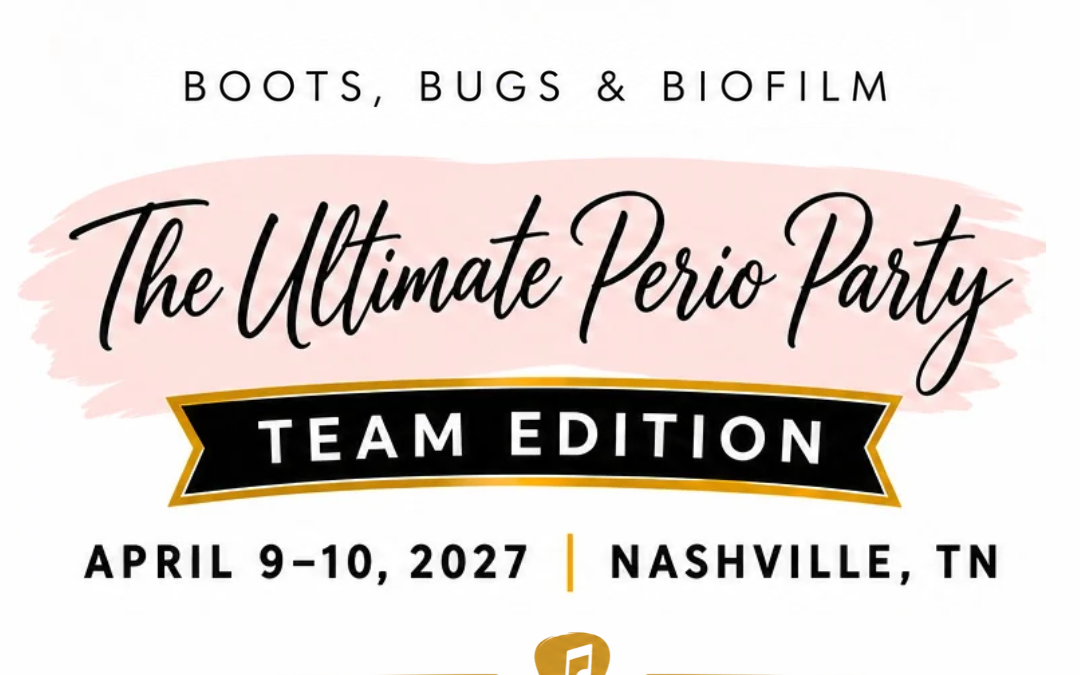
Boots, Bugs & Biofilm LIVE IN NASHVILLE — The Ultimate Perio Party: Team Edition

Boots, Bugs & Biofilm LIVE IN NASHVILLE — The Ultimate Perio Party: Team Edition

Looking for dental continuing education in Nashville, Tennessee? Join Boots, Bugs & Biofilm™ April 9–10, 2027, for The Ultimate Perio Party: Team Edition!

This two-day dental CE event offers 12 live continuing education credits and practical, science-driven periodontal education for dentists, dental hygienists, and the entire dental team.

Explore oral-systemic health connections, bacterial testing, microscopy, precision periodontal protocols, patient communication, coding, and implementation strategies designed to strengthen your hygiene department.

Bring your dental team and leave with practical tools and the confidence to put them into action!

April 9–10, 2027 | Nashville, Tennessee

12 Live CE Credits

Join us in Nashville for Boots, Bugs & Biofilm LIVE — The Ultimate Perio Party: Team Edition!

This two-day continuing education experience is designed for dentists, dental hygienists, and the entire dental team.

Discover practical, science-driven strategies to transform your hygiene department, strengthen patient care, and build confidence with protocols you can implement immediately.

From oral-systemic connections and bacterial testing to microscopy, precision periodontal protocols, patient communication, and implementation strategies, you’ll leave with the tools and confidence to elevate your perio program.

WHAT YOU’LL LEARN

🦠 Oral-Systemic Connections: New and current research and what it means for patient care.

🦠 Bacterial Testing: How it works, when to test, and what the bad bugs mean.

🦠 Precision Periodontal Protocols: Plug-and-play protocols that are easy to implement with predictable results.

🔬 Microscopy: Show patients their own bacteria and watch perio get personal.

💬 Verbal Skills: Get the script you wish they taught you in school.

✅ Systems & Implementation: Turn evidence into a simple, consistent in-office workflow.

📋 Coding With Confidence: Know what to code so you can get paid for your care.

THE BBB EXPERIENCE

We’re bringing back our signature BBB Trucker Hat Bar!

Enjoy two days of education, collaboration, team building, and the fun that makes Boots, Bugs & Biofilm different from your typical dental CE course.

Bring your dental team and leave ready to put what you’ve learned into action!

LOCATION

Homewood Suites by Hilton Nashville Vanderbilt
2400 West End Avenue
Nashville, TN 37203

Discounted rooms available within our hotel block.

REGISTRATION

$895 — 12 Live CE Credits
$595 — Admin Ticket (No CE credits provided)

QUESTIONS?  Download flyer

Email: contact@bootsbugsandbiofilm.com

Website: www.bootsbugsandbiofilm.com

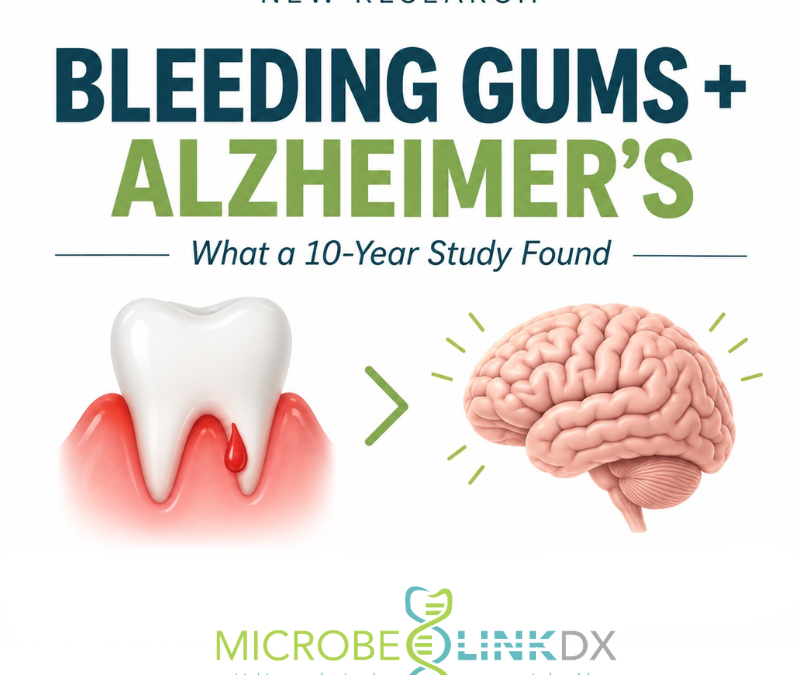
Bleeding on Probing & Alzheimer’s: What a New 10-Year Study Found

Bleeding on Probing & Alzheimer’s: What a New 10-Year Study Found

Bleeding Gums & Alzheimer’s: What a New 10-Year Study Found

Could bleeding gum tissue tell us something about more than oral health?

A new 2026 study published in the Journal of Clinical Periodontology followed 1,396 adults age 60 and older for 10 years to examine whether periodontal health was associated with the development of dementia.

The researchers evaluated three familiar periodontal measurements:

  • Probing pocket depth (PPD)
  • Clinical attachment level (CAL)
  • Bleeding on probing (BOP)

During the 10-year follow-up, 267 participants developed dementia, including 194 cases of Alzheimer’s disease and 51 cases of vascular dementia.

🧠 What Did Researchers Find?

Compared with participants in the lowest groups, those in the highest quartiles at baseline had:

72% higher relative risk associated with deeper probing depths
59% higher relative risk associated with greater clinical attachment loss
56% higher relative risk associated with greater bleeding on probing

Most interestingly, increasing levels of bleeding on probing were also significantly associated with Alzheimer’s disease risk.

These are relative comparisons between groups — they do not mean that a patient with bleeding gum tissue has a 56% chance of developing dementia.

🦷 Why Does Bleeding Matter?

Bleeding on probing is something dental professionals see every day, but it shouldn’t be dismissed as simply “normal bleeding.”

It is a clinical sign of inflammation.

Periodontal disease is a chronic inflammatory condition involving a complex interaction between the host immune response and the microbial community below the gumline.

Research continues to investigate how chronic periodontal inflammation and periodontal pathogens may connect with systemic health.

This study doesn’t prove that periodontal disease causes dementia or Alzheimer’s disease. What it does show is an important long-term association between poorer periodontal health and subsequent dementia risk in this population.

🔬 Where Does Bacterial Testing Fit?

Bleeding tells us inflammation is present.

Bacterial testing can provide another piece of the clinical picture by helping identify and quantify the periodontal pathogens present.

MicrobeLink Dx® uses paper points collected from periodontal pockets and qPCR to identify 11 key periodontal pathogens, providing clinicians with additional information to use alongside probing depths, bleeding, radiographs, medical history and clinical judgment.

🎥 Watch: Bleeding Gums & Alzheimer’s

In this short video, Jennifer Seider, RDH, breaks down the new research and explains why bleeding gum tissue deserves our attention.

The Takeaway

Bleeding is information.

This study adds to a growing body of research examining the relationship between periodontal health, chronic inflammation and brain health.

For dental professionals, it’s another reason to identify periodontal inflammation early, determine what’s driving the disease and help patients understand why periodontal health is about much more than their teeth.

Read the study on PubMed

Questions about incorporating bacterial testing into your periodontal protocol?
Contact MicrobeLink Dx® or ask about a complimentary team Zoom.

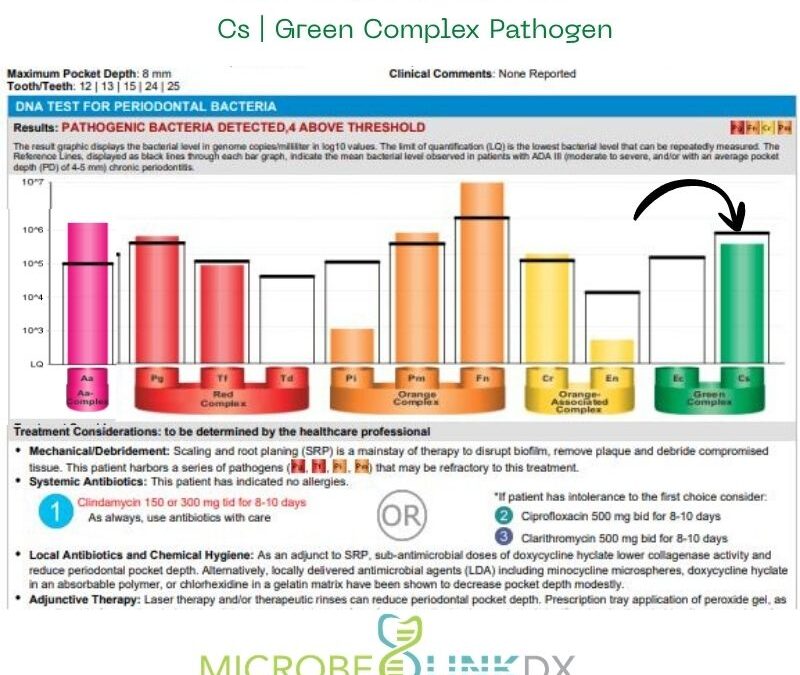
Capnocytophaga sp. (Cs): The Immune Watcher

Capnocytophaga sp. (Cs): The Immune Watcher

Meet Cs: The Immune Watcher 👀

Immune-Response Associated | Green Complex

Capnocytophaga species — or Cs — can be present at low levels in the mouth, but the amount matters.

Think of Cs as “The Immune Watcher.”

Cs is associated with gum inflammation and may become more relevant in patients experiencing changes in immune response. When levels are elevated, Cs may contribute to ongoing gum irritation or difficulty healing.

Quick way to remember Cs:

🟢 Green Complex
👀 The Immune Watcher
🦠 Can be present at low levels
🛡️ Think changes in immune response
🌡️ Elevated levels may contribute to ongoing irritation
🩹 Think difficulty healing

Seeing Cs on a MicrobeLinkDx® Report?

This is a great example of why the bacterial level matters. Don’t look only at whether Cs is present—look at the amount detected, the other bacteria present, and what’s happening clinically.

Interpreting My Results →

Cs Research & Updates

We’ll continue adding new research, oral-systemic findings, clinical information, and resources related to Cs as they become available.

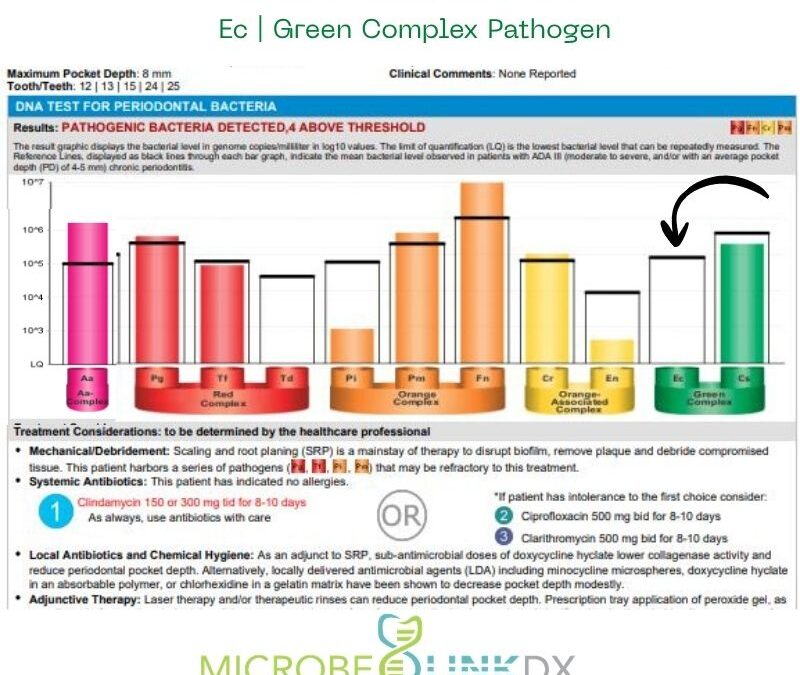
Eikenella corrodens (Ec): The Opportunist

Eikenella corrodens (Ec): The Opportunist

Meet Ec: The Opportunist 🦠

Opportunistic Pathogen | Green Complex

Eikenella corrodens — or Ec — is a little different from some of the other bugs we’ve met.

Think of Ec as “The Opportunist.”

Ec is usually found alongside other bacteria and may become more significant in patients with medical conditions or immune challenges.

It can contribute to persistent gum inflammation and is sometimes associated with mixed infections involving dental implants.

Quick way to remember Ec:

🟢 Green Complex
👀 The Opportunist
👥 Usually found with other bacteria
🩺 May be more significant with medical or immune challenges
🌡️ Think persistent inflammation
🦷 Can be associated with mixed implant infections

Seeing Ec on a MicrobeLinkDx® Report?

With an opportunistic pathogen like Ec, look at the whole picture—the bacterial level, what other pathogens are present, and what’s happening clinically.

Interpreting My Results →

Ec Research & Updates

We’ll continue adding new research, oral-systemic findings, clinical information, and resources related to Ec as they become available.

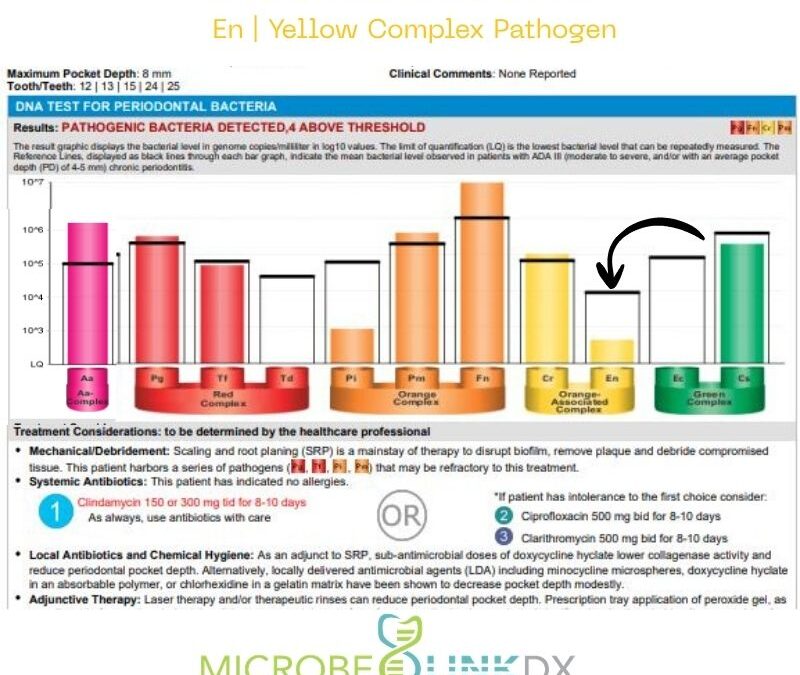
Eubacterium nodatum (En): The Long-Hauler

Eubacterium nodatum (En): The Long-Hauler

Meet En: The Long-Hauler 🦠

Immune-Response Associated Pathogen | Yellow Complex

Eubacterium nodatum — or simply En — is typically found in more advanced periodontal disease and often shows up alongside other high-risk bacteria.

Think of En as “The Long-Hauler.”

When En is present, it may be another clue that we’re dealing with a more severe or long-standing periodontal infection—especially when the rest of the bacterial profile and clinical findings tell the same story.

Quick way to remember En:

🟡 Yellow Complex
⏳ The Long-Hauler
🦠 Immune-response associated pathogen
📈 Think more advanced disease
👥 Often found with other high-risk bacteria
⏳ May point toward a more severe or long-standing infection

Seeing En on a MicrobeLinkDx® Report?

En shouldn’t be interpreted by itself. Look at its level, the other bacteria detected, and the patient’s clinical findings to understand the overall picture.

Interpreting My Results →

En Research & Updates

We’ll continue adding new research, oral-systemic findings, clinical information, and resources related to En as they become available.

Campylobacter rectus (Cr): The Persistent Mover

Campylobacter rectus (Cr): The Persistent Mover

Meet Cr: The Persistent Mover 🏃

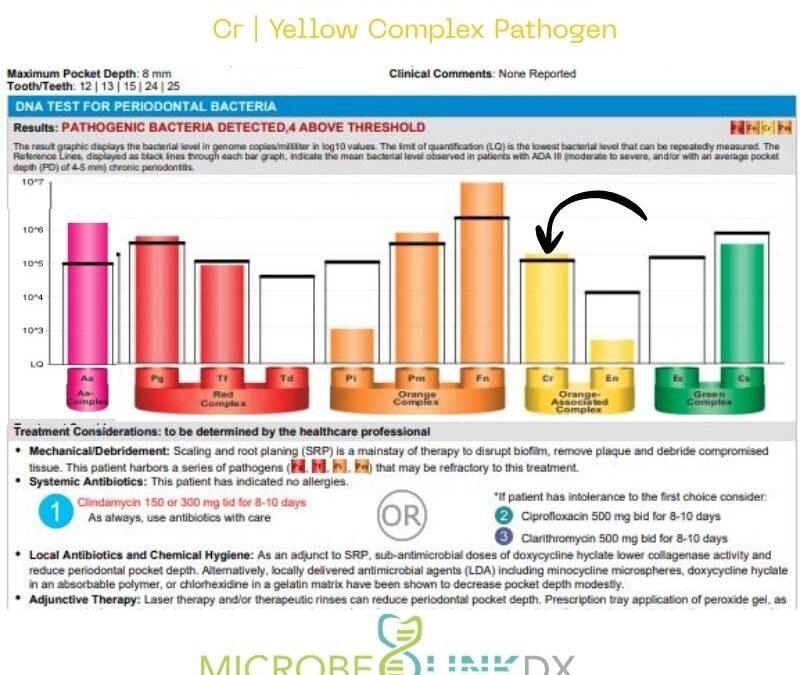
Motile Periodontal Pathogen | Yellow Complex

Campylobacter rectus — or Cr — is a motile periodontal pathogen associated with ongoing inflammation and disease progression.

Think of Cr as “The Persistent Mover.” It’s more commonly detected in advanced periodontal disease and may contribute to tissue breakdown when infection continues.

Cr has also been linked with inflammation around dental implants. When periodontal infection persists or isn’t responding as expected, Cr may be another piece of the bacterial puzzle.

Quick way to remember Cr:

🟡 Yellow Complex
🏃 The Persistent Mover
🦠 Motile periodontal pathogen
🌡️ Think ongoing inflammation
📈 More commonly detected in advanced periodontal disease
🦷 Associated with implant inflammation
🔄 May be present when infection persists or doesn’t respond as expected

Seeing Cr on a MicrobeLinkDx® Report?

Look at the Cr level along with the other bacteria detected and the patient’s clinical findings to understand the overall microbial picture.

Interpreting My Results →

Cr Research & Updates

We’ll continue adding new research, oral-systemic findings, clinical information, and resources related to Cr as they become available.