
Welcome to the Blog

Updates and News

Oral-Systemic info Articles

New Cardiology Study Links Childhood Oral Health to Adult Cardiovascular Disease

New Cardiology Study Links Childhood Oral Health to Adult Cardiovascular Disease

New Research Highlights the Lifelong Impact of Oral Health

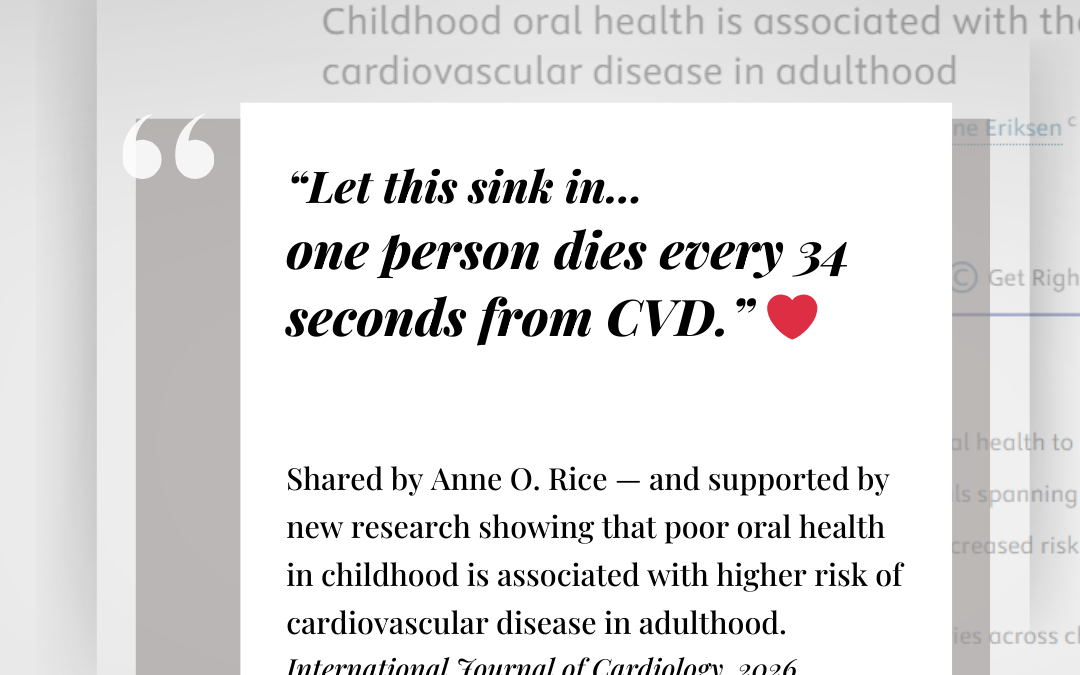
A newly published study in the International Journal of Cardiology (April 2026) adds powerful evidence to the growing body of research connecting oral health and systemic disease.

This large, nationwide cohort study followed over 568,000 individuals for more than 20 years and found that poor oral health in childhood was associated with a significantly higher risk of atherosclerotic cardiovascular disease (ASCVD) in adulthood, including ischemic heart disease, myocardial infarction, and stroke.

Even more concerning, individuals whose oral health remained poor or worsened throughout childhood demonstrated the greatest long-term cardiovascular risk.


Why This Matters for Oral–Systemic Health

While oral health has long been linked to cardiovascular disease in adults, this study highlights that the foundation may begin much earlier in life. Chronic oral inflammation, gingivitis, and early periodontal disease may contribute to systemic inflammatory pathways that influence cardiovascular outcomes decades later.

Periodontal disease is driven by specific pathogenic bacteria—such as Porphyromonas gingivalis, Fusobacterium nucleatum, Tannerella forsythia, Aggregatibacter actinomycetemcomitans, and others—that are known to trigger inflammatory responses beyond the oral cavity.

Although this study did not rely on modern microbial testing methods, it reinforces the importance of early identification and management of oral inflammation to support lifelong health.


The Role of Salivary and Periodontal Diagnostics

Advances in salivary testing and site-specific periodontal sampling now allow clinicians to better understand bacterial activity and inflammatory burden earlier and more precisely than ever before.

Salivary diagnostics can help screen for risk and monitor inflammatory markers, while periodontal assessments and bacterial analysis provide insight into the microbial drivers of disease. Together, these tools support a more proactive, preventive approach to oral and systemic health.


Oral Health Is Whole-Body Health

This cardiology research reinforces a message that continues to gain momentum across medicine and dentistry:
oral health is not isolated—it is deeply connected to overall health outcomes.

Investing in prevention, early intervention, and education around periodontal health may have benefits that extend far beyond the mouth.


🔗 Reference

International Journal of Cardiology (2026)
“Childhood oral health is associated with the incidence of atherosclerotic cardiovascular disease in adulthood.”
👉 https://www.internationaljournalofcardiology.com/article/S0167-5273(25)01194-5/fulltext
🔥 Inflammation Starts in the Mouth-🎥

🔥 Inflammation Starts in the Mouth-🎥

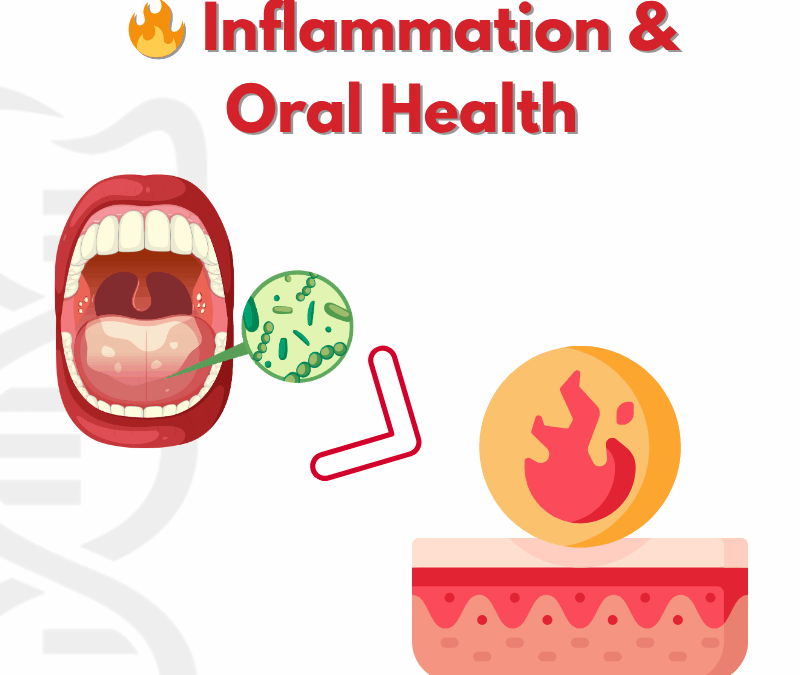
🔥 Inflammation Starts in the Mouth

Featuring medical commentary from Dr. Michael Roizen (Cleveland Clinic) and excerpts from the documentary Say Ahh: A Film About Oral Health

How oral bacteria ignite whole-body inflammation

Chronic inflammation is the hidden driver behind many systemic diseases — including heart disease, stroke, diabetes, preterm birth, and even cognitive decline.
One of the most overlooked sources of this inflammation is oral infection.

High-risk periodontal pathogens living deep in the gum pockets can enter the bloodstream, elevate inflammatory markers, and contribute to systemic illness.

This short medical video explains how inflammation begins, how it spreads, and why controlling inflammatory triggers is essential for long-term health.

🎥 Watch the Inflammation Video

🧬 Evidence: Inflammation & Oral Health Research

Explore three clinically supported inflammation resources:

1️⃣ High-Risk Oral Pathogens & Cardiovascular Inflammation

Bale–Doneen & Vigerust (2016)
https://pubmed.ncbi.nlm.nih.gov/26782880/

2️⃣ Periodontal Inflammation & Preterm Birth Risk

Periodontal disease & pregnancy outcomes
https://pubmed.ncbi.nlm.nih.gov/31606345/

3️⃣ Reducing Oral Infection Lowers Systemic Inflammation

Periodontal therapy reduces CRP
https://pubmed.ncbi.nlm.nih.gov/15153866/

These articles support what we see every day:
👉 inflammation often begins in the mouth — but it doesn’t stay there.


💡 Why This Matters

Identifying high-risk bacteria early with MicrobeLink Dx® allows dental teams to reduce inflammatory load at the source.
This approach strengthens periodontal therapy and supports whole-body health.

👉 Download our free patient inflammation flyer

Gum Disease and Migraines: The Unexpected Connection in New Research

Gum Disease and Migraines: The Unexpected Connection in New Research

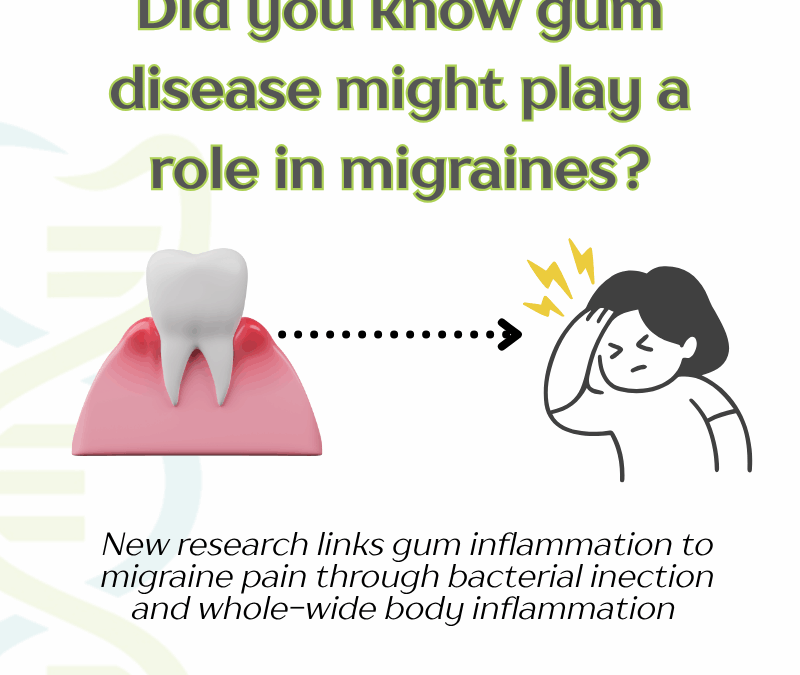
🧠 New research: oral bacteria may play a role in migraine pain

A 2025 systematic review in the European Journal of Neurology reveals that individuals with periodontal disease are more likely to experience migraines. Researchers believe that inflammation and bacteria from the gums can enter the bloodstream and affect blood vessels and nerves that trigger head pain.

🔬 How Oral Bacteria Play a Role

Pathogens such as Porphyromonas gingivalis and Fusobacterium nucleatum release toxins that stimulate the immune system and increase cytokines like IL-6 and TNF-α—molecules also implicated in migraine pathways.

💡 Why This Matters

Gum disease is an infection—often silent, but never isolated to the mouth. Detecting the specific bacteria responsible can help providers treat infection early and reduce the inflammatory load that affects the whole body.

🧬 Testing for the Cause

The MicrobeLink Dx® 11-Microbes® Test identifies the exact pathogens driving inflammation at the base of the gum pocket—where systemic disease often begins. Early testing means early treatment and a healthier mouth-body connection.

📖 Source: European Journal of Neurology. 2025. Association Between Migraine and Periodontitis: A Systematic Review and Meta-Analysis. Read the study here →

Bad Breath and Gum Disease: How Oral Bacteria Cause Halitosis

Bad Breath and Gum Disease: How Oral Bacteria Cause Halitosis

Bad Breath and Gum Disease: What the Science Says

Why Bad Breath Happens

If you’ve ever worried about bad breath, you’re not alone. It’s one of the most common concerns patients bring up — but it’s also one of the most misunderstood.

Most people assume bad breath (halitosis) comes from food or poor hygiene, but in reality, it often starts below the gumline. When bacteria build up around the teeth and gums, they release smelly sulfur gases — the same bacteria that cause gum inflammation and periodontal disease.

The Hidden Connection Between Bad Breath and Gum Disease

Research continues to show that bad breath and gum infection share the same bacterial source.

Certain microbes such as Porphyromonas gingivalis, Fusobacterium nucleatum, and Tannerella forsythia not only damage gum tissue — they also create volatile sulfur compounds (VSCs), the primary cause of persistent bad breath.

Over time, these bacteria can damage the soft tissue and bone that support your teeth, while also affecting your confidence and social comfort.

Why Mints and Mouthwash Don’t Work

Breath fresheners only mask the problem — they don’t reach the bacteria deep below the gumline. If you’ve tried rinses, gums, and sprays and still notice odor, that’s your sign to look deeper.

The good news? Modern testing can detect these bacteria early so your dental team can treat the infection at the source.

The Only Way to Know for Sure

Here’s the truth most people never hear:
You can’t see bacteria. You can’t smell which species are there. And you can’t treat what you don’t test.

The only way to identify harmful bacteria is through a bacterial culture or DNA-based test.

That’s exactly what we do at MicrobeLink Dx®.
Our 11-Microbes® Test looks for the most aggressive bacteria that cause bad breath, bleeding gums, and even systemic health risks — so your dental team can treat the actual cause, not just mask the symptoms.

Why This Matters

Bad breath is a sign that something deeper is happening. Ignoring it means the bacteria keep growing — and the infection keeps spreading.
Testing gives you answers.
Treatment gives you relief.

Because fresh breath doesn’t come from a mint.
It comes from a healthy, bacteria-free mouth.

Further Reading & Publications

If you’d like to learn more, here are three excellent studies exploring the connection between oral bacteria, gum disease, and bad breath:

1️⃣ Lee Y-H, Hong J-Y. Oral microbiome as a co-mediator of halitosis and periodontitis: a narrative review. Front Oral Health. 2023;4:1229145.
Read the study here →

2️⃣ Lee Y-H, Shin S-I, Hong J-Y. Investigation of volatile sulfur compound level and halitosis in patients with gingivitis and periodontitis. Sci Rep. 2023;13:13175.
Read the study here →

3️⃣ De Geest S, Quirynen M. Periodontal diseases as a source of halitosis: a review. Periodontol 2000. 2016;70:213–227.
Read the study here →

Oral Bacteria Linked to Alzheimer’s Disease: Understanding the Role of Porphyromonas gingivalis

Oral Bacteria Linked to Alzheimer’s Disease: Understanding the Role of Porphyromonas gingivalis

🧠 Oral Bacteria Linked to Alzheimer’s Disease

The Mouth–Brain Connection

A 2020 study published in Frontiers in Cellular and Infection Microbiology found something surprising: the same bacteria that cause gum disease were discovered in the brains of people with Alzheimer’s disease.

The bacteria, called Porphyromonas gingivalis (P. gingivalis), release toxins that can damage brain cells and trigger inflammation. Over time, that inflammation may play a role in memory loss and Alzheimer’s disease.

👉 Read the full study on PubMed Central

What This Means

Gum disease isn’t just a mouth problem — it’s an infection. When harmful bacteria live under the gums, they can enter the bloodstream and travel to other parts of the body, including the brain.

Researchers believe this mouth-to-brain connection may be one reason why people with long-term gum infections have a higher risk for Alzheimer’s disease.

How to Catch These Bacteria Early

With the MicrobeLink Dx’s 11-Microbes Test, dental providers can find out if high-risk bacteria like P. gingivalis are active in your mouth.

This simple test uses paper points to collect bacteria from the base of the gums — where infection starts. Detecting the bacteria early allows for targeted treatment before they spread.

Protecting More Than Your Smile

Healthy gums don’t just help your teeth — they may also help protect your brain, heart, and overall health.

Ask your dental provider if bacterial testing is right for you, or visit www.microbelinkdx.com to learn more.