
Welcome to the Blog

Updates and News

Practice Resources Articles

Peri-Implantitis & Bacteria: Why Implants Fail and How to Protect Them | MicrobeLink Dx®

Peri-Implantitis & Bacteria: Why Implants Fail and How to Protect Them | MicrobeLink Dx®

Implant Failure & Bacterial Testing: What the Latest Research Shows

Dental implants can fail for many reasons — but one of the most overlooked is bacterial imbalance.
New research shows that the same microbes driving gum disease can also cause implant failure, making bacterial testing a key step in prevention.

🧫 The Top 5 Pathogens Linked to Failing Implants

Recent studies have identified five key pathogens that show up again and again in peri-implant infections:
Porphyromonas gingivalis (Pg), Tannerella forsythia (Tf), Prevotella intermedia (Pi), Treponema denticola (Td), and Fusobacterium nucleatum (Fn). These bacteria don’t just live on the surface — they invade tissue, disrupt healing, and trigger inflammation that can lead to bone loss and implant mobility.  If your patient tests positive for one or more of these microbes, it’s important to treat aggressively and early to protect both the implant and surrounding structures.

📚 What the Research Says

Here’s a look at three recent studies confirming the strong link between peri-implantitis and these bacteria:

1️⃣ Meta-Analysis: Key Pathogens in Peri-Implantitis (2022)

Archilla & Palma-Casiano, Journal of Inflammatory Diseases
Read the full study →
This review found peri-implantitis sites were 2–3× more likely to contain Pg, Tf, Pi, Td, and Fn compared to healthy implants.
💡 The same pathogens our MicrobeLink Dx® test identifies.

2️⃣ Systematic Review: Microbial Profile Associated with Peri-Implantitis (Shibli et al., 2019)

Reference: Shibli, J.A. et al. Microbial profile associated with peri-implantitis: A systematic review. Journal of Periodontology, 2019.
Read the abstract on PubMed →

Researchers reviewed dozens of studies to pinpoint which bacteria are most often found around failing implants.
Across every paper, the same pattern appeared — Porphyromonas gingivalis (Pg), Tannerella forsythia (Tf), Treponema denticola (Td), Prevotella intermedia (Pi), and Fusobacterium nucleatum (Fn) were consistently elevated in peri-implantitis compared to healthy sites.

These are the same red-complex and orange-complex pathogens that drive aggressive periodontal disease. Their presence around implants signals active infection, tissue destruction, and risk for early bone loss.

💡 Takeaway: The Shibli review reinforces that identifying these pathogens with bacterial DNA testing helps clinicians act early, personalize therapy, and protect both the implant and surrounding bone before failure occurs.

3️⃣ Longitudinal Study: Microbiome Shifts in Peri-Implantitis (2025)

Anuntakarun et al., Journal of Dentistry
Read the full study →
This six-month study tracked implants before and after treatment. Sites with peri-implantitis showed high levels of Prevotella, Fusobacterium, Pg, Tf, and Td that decreased once therapy began — proving that controlling these pathogens supports healing.
💡 When the bacteria improve, so does the outcome.


💚 How to Sample for Implant Testing

When testing around implants or before placement:
1️⃣ Use our provided paper points for testing
2️⃣ Place them in the deepest pockets, or around the implant in question.
3️⃣ For surgical planning, sample the area where the implant will be placed.
4️⃣ Send the paper points back to the lab using our free UPS 2-Day Air shipping — results are ready in about 72 hours after lab receipt.

Why MicrobeLink Dx®

MicrobeLink Dx® identifies 11 key bacteria linked to periodontal and peri-implant disease.
We provide:

  • Free kits and prepaid shipping
  • Fast turnaround

  • A color-coded, easy-to-read report

  • And personalized customer support — our team walks you through every step

Because the science is powerful — but our support makes it personal. 💚

🔗 Download & Share

📎 Download the “Bacteria Behind Failing Implants” Flyer (PDF)
Use it in your practice, add it to patient education materials, or share it with your implant team.


🧬 MicrobeLink Dx® — The Science Behind the Smile

Learn more at www.microbelinkdx.com
Perio Power Hour: Where Science Meets Systems!

Perio Power Hour: Where Science Meets Systems!

Perio Power Hour brings the science behind the smile to life — connecting bacterial testing, clinical systems, and team-based perio care.

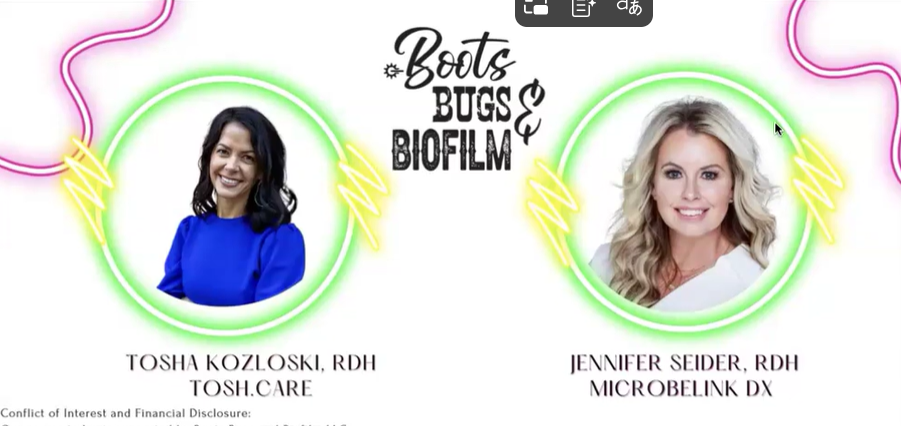
Join Jennifer Seider and Tosha Kozloski, creators of Boots, Bugs & Biofilm, as they dive into:

  • How oral pathogens drive inflammation and systemic impact

  • Why precision diagnostics change everything in perio care

  • Real-world strategies for implementing testing in your hygiene workflow

  • How the 11-Microbes® report supports patient communication and treatment planning

This high-energy session was created for dental teams who want to bridge the gap between science and systems — and build a truly precision-based perio program

🔸 Boots, Bugs & Biofilm™ — The Ultimate Team Edition

Learn the science, systems, and Southern sparkle behind precision perio therapy.
🎓 Join us for our next live training event →
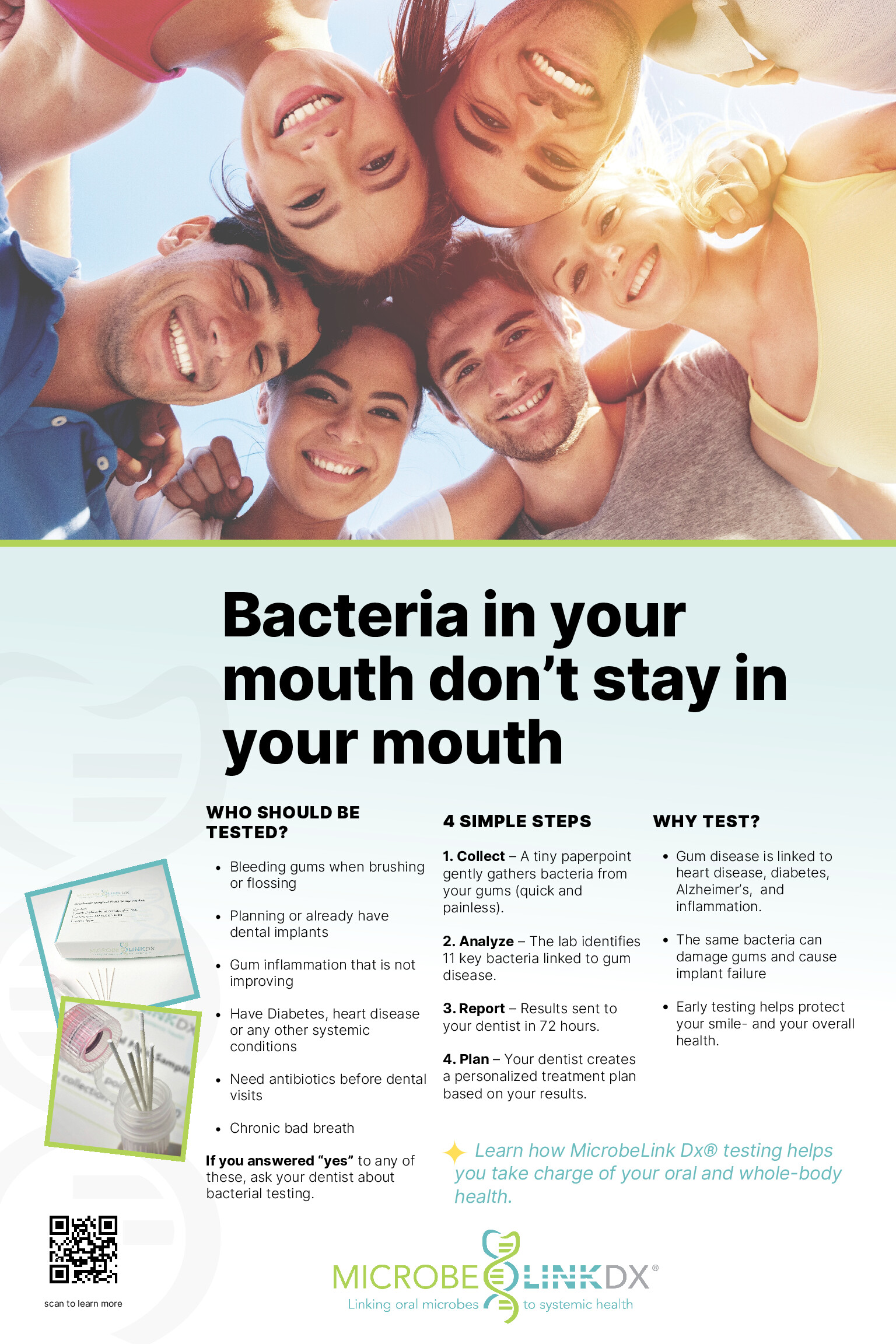
Bacteria in Your Mouth Don’t Stay in Your Mouth — Free Printable Poster for Dental Offices

Bacteria in Your Mouth Don’t Stay in Your Mouth — Free Printable Poster for Dental Offices

Bacteria that cause gum disease don’t just stay in your mouth — they can travel through inflamed tissues into the bloodstream and affect the rest of your body.
This educational poster helps your patients visualize how oral health connects to systemic health. It’s perfect for your operatory, consultation room, or waiting area.

🖨️ How to Print This Poster

You can easily print this high-quality poster through Staples Custom Printing:
👉 Order through Staples Custom Posters

Recommended print options:

  • Size: 12×18 (if you want bigger reach out!)

  • Finish: Gloss or Satin

  • Mounting: Foam board (optional but professional-looking)

Simply upload the file below, choose your local Staples store, and you can usually pick it up the same day.

Want It Customized?

We can personalize this poster with your office logo and contact information at no extra cost for MicrobeLink Dx® testing offices.
Just email jennifer@microbelinkdx.com with your logo file, and we’ll send back a customized print-ready version.

📎 Download the Poster File Here

💬 About MicrobeLink Dx®

MicrobeLink Dx® helps dental professionals identify the 11 key pathogens linked to gum disease and systemic inflammation using paper-point bacterial sampling. Early detection means early treatment — before bone loss and before bacteria spread systemically.

How to Collect a MicrobeLink Dx® Bacterial Sample | Easy Step-by-Step Guide

How to Collect a MicrobeLink Dx® Bacterial Sample | Easy Step-by-Step Guide

Learn how simple it is to collect a bacterial sample with MicrobeLink Dx®! 🦠✨

With just a few quick steps, you can gather samples directly from the periodontal pocket using sterile paper points. Our 11-Microbes® DNA-PCR test detects the exact bacteria driving gum disease—helping you personalize treatment and protect not only your patients’ smiles but also their overall health.

What you’ll see in this video:
✅ How to prepare the site
✅ Proper paper point insertion technique
✅ How to package and return samples
✅ Why bacterial testing matters for oral & systemic health

📦 Free test kits | 💻 72-hour results online | 📊 Simple, color-coded reports

📅 Book a free Zoom walkthrough: https://calendly.com/microbelinkdx/30

Who Should Be Tested with MicrobeLink Dx®? | 11-Microbes DNA-PCR Test

Who Should Be Tested with MicrobeLink Dx®? | 11-Microbes DNA-PCR Test

🦠 Not every patient needs bacterial testing… but the right ones do.
With MicrobeLink Dx®, you can identify the patients most at risk—catching infection early and preventing bigger problems down the road.

Who should be tested?
✔️ Patients with bleeding gums (an early warning sign)
✔️ Those with pocket depths of 5mm+
✔️ Implant patients (to ensure a bacteria-free foundation)
✔️ Patients with systemic health conditions like diabetes or heart disease
✔️ Patients resistant to therapy or with persistent issues

MicrobeLink Dx® makes testing simple, affordable, and precise. Collect samples directly from the pocket with paper points and get clear, color-coded results within 72 hours.

📊 Early detection = better treatment outcomes.
📦 Free kits | 💻 Online reports | 🚀 Results in 72 hours

🌐 Learn more or request your free kits at: www.microbelinkdx.com
📅 Book a free Zoom walkthrough: https://calendly.com/microbelinkdx/30

New Patient Education info!  Periodontal Health 101: Understanding Your 11-Microbes Test Results

New Patient Education info! Periodontal Health 101: Understanding Your 11-Microbes Test Results

How to Understand 11-Microbes Test Results and Treatment Options

If you have been diagnosed with periodontal disease, you may have taken an 11-microbes test to determine the type and level of bacteria in your mouth. This test is a powerful tool that helps your dentist create a personalized treatment plan for you. But what does the test report mean and how can you use it to improve your oral health?

To help you answer these questions, we have created two patient information pages that explain everything you need to know about the 11-microbes test. These pages are easy to read, informative, and user-friendly. They will help you understand your test results and treatment options better.

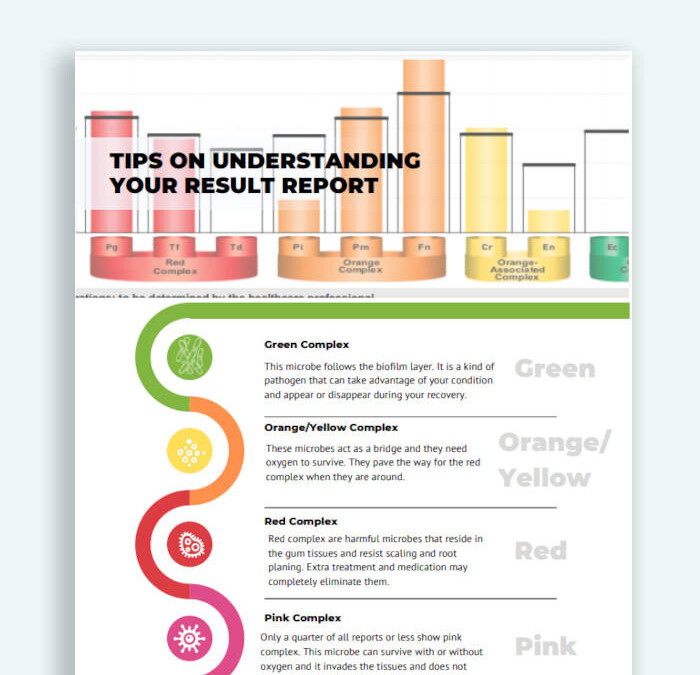
The first page is a guide on how to interpret your result report. It covers the following topics:

  • What is the 11-microbes test and why is it important?
  • How to read the report and what each section means
  • What are the normal ranges and what do they indicate?
  • What are the possible treatment options and how to choose the best one for you?
  • What are the benefits of taking the test and following the treatment plan?
  • How to monitor your progress and prevent recurrence of periodontal disease?

You can download this page  Here

The second page is to explain why you may need an 11-microbes test and how it can help you. It covers the following topics:

  • What are the signs and symptoms of periodontal disease?
  • How does periodontal disease affect your overall health and well-being?
  • What are the risk factors and causes of periodontal disease?
  • How does the 11-microbes test work and what does it measure?
  • How can the 11-microbes test help you prevent, treat, and manage periodontal disease?

You can download this page Here

These patient information pages are a valuable resource that you can use to educate yourself and your family about your health condition. We recommend that you print them out and add them to your patient info packet for future reference.

If you have any feedback or suggestions on how we can improve these pages, please let us know. We appreciate your input and support. Thank you for choosing us. 😊